Salesforce 0—>1 Employee Experience product for employee efficiency and commercialization
As a UX Design contractor at Salesforce, I co-led the creation of a 0—>1 MVP concept of an Employee Experience Cloud - taking it from problem & opportunity, to design concept, to getting leadership buy-in, to a live, functioning MVP. We worked closely with our Product and Engineering teams to define an extensive roadmap, paving the way towards external commercialization.
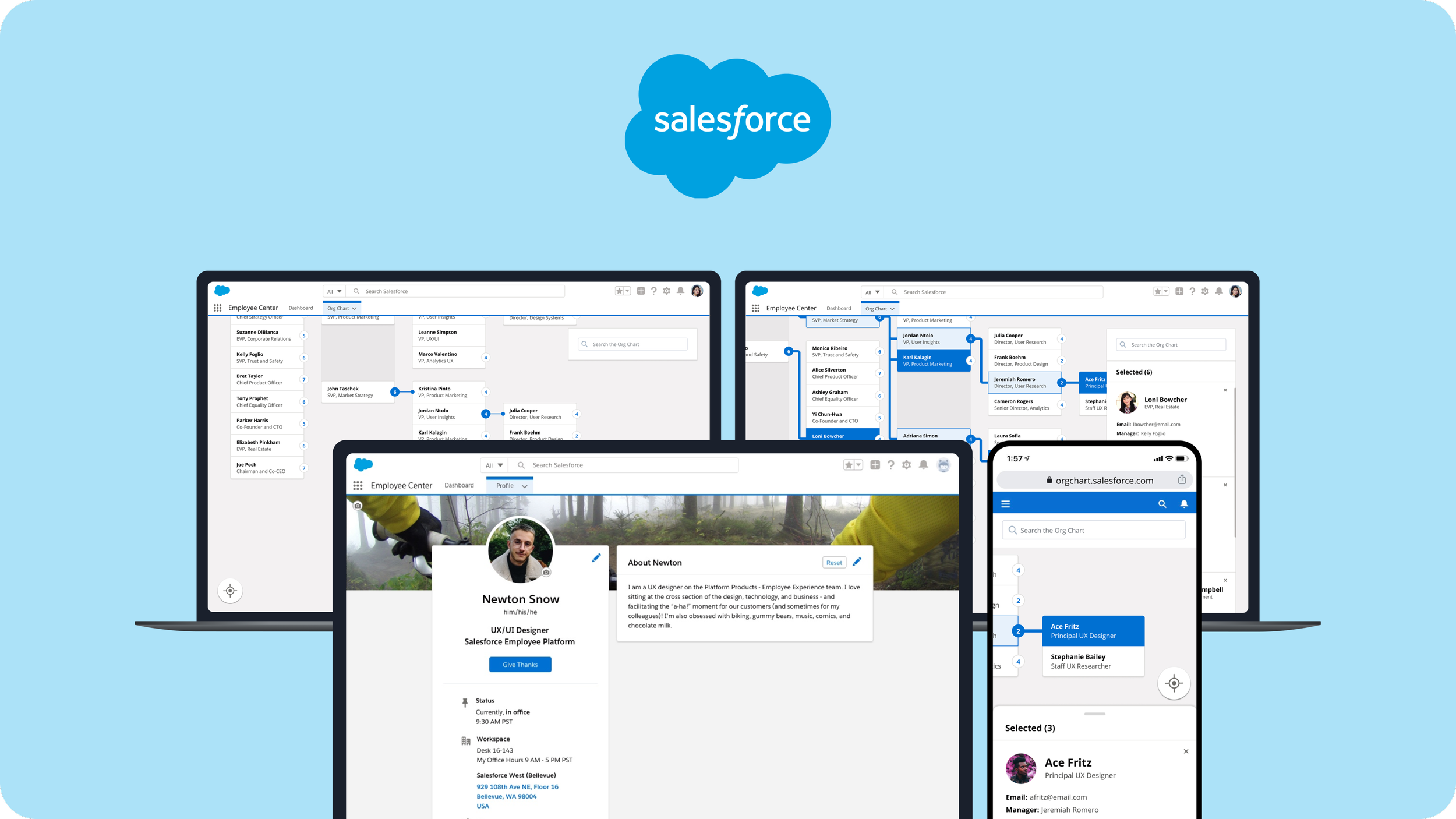
Impact
Designed and delivered an MVP version of the Employee Cloud, collaborating with Engineering in building it out until my contract ended
Received leadership buy-in for further work and funding towards external commercialization
MVP product 1 - Profile Page
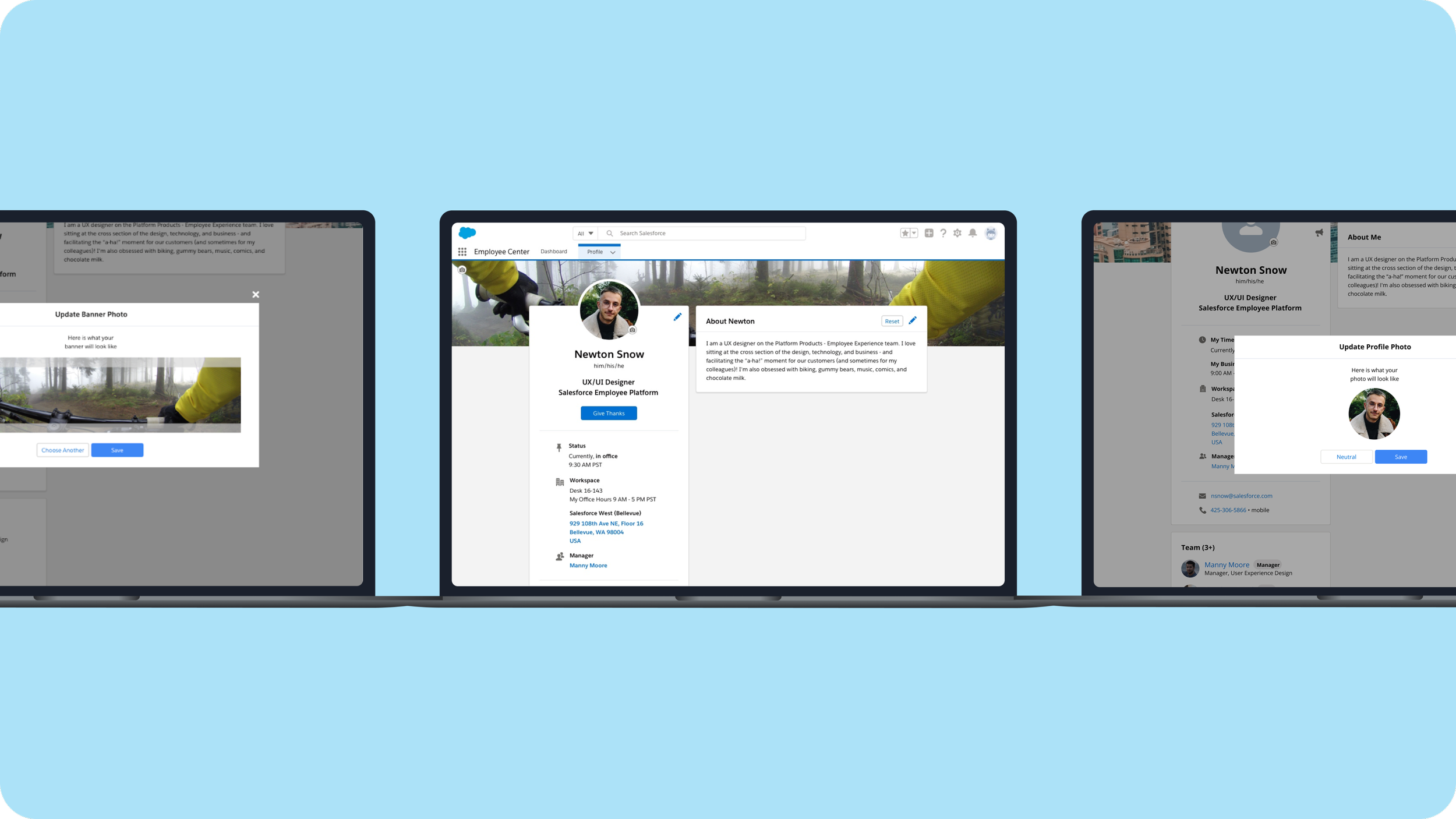
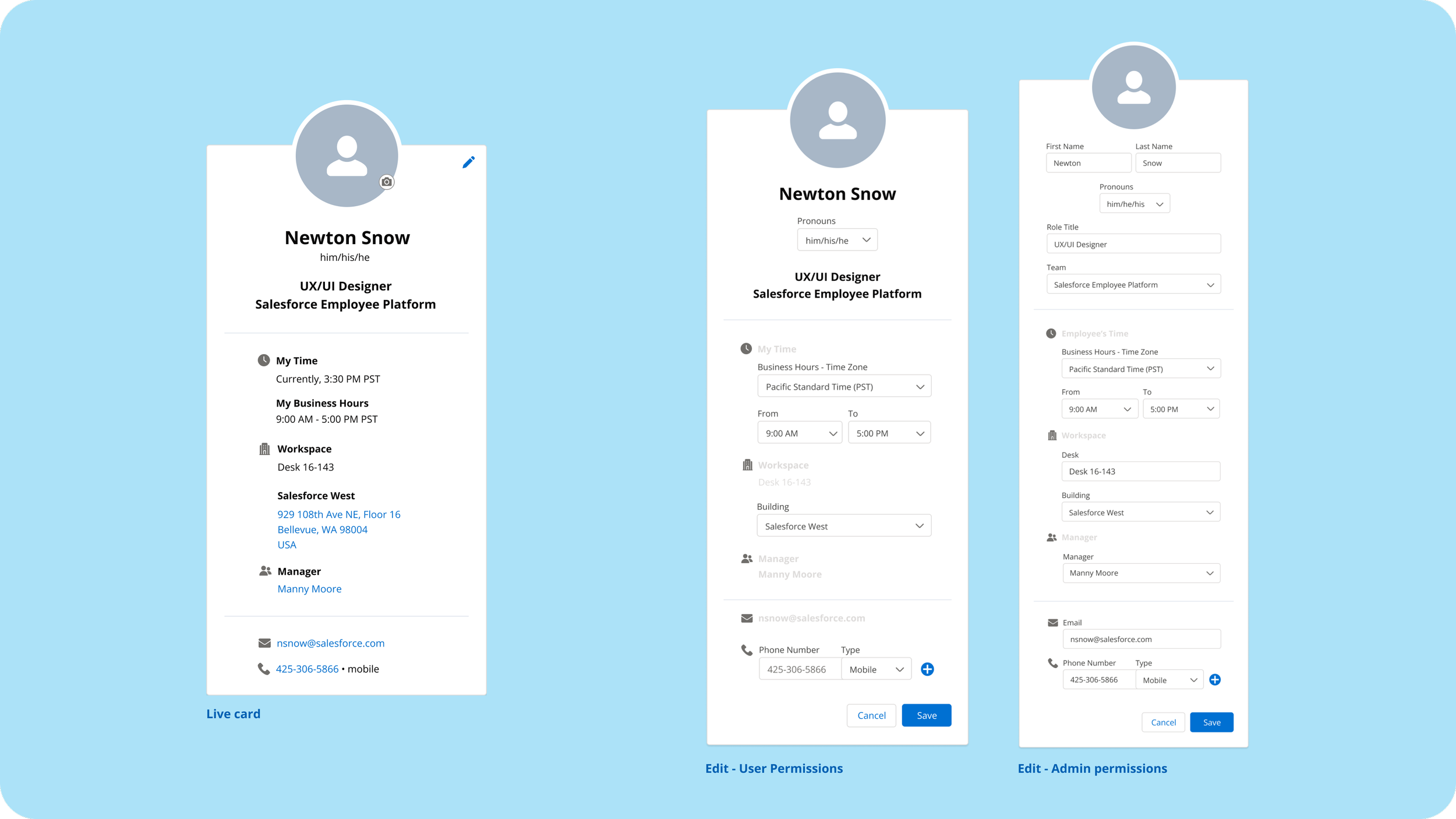
As a part of creating a new Design System for this product, I defined variations for several components to incorporate logic such as User and Admin Permissions.
MVP product 2 - redesigned Organization Chart


Context
In 2019, teams within Salesforce identified a huge opportunity to further support its employees, help the company grow, and further stand out from its competitors - building an Employee Cloud.
They envisioned building out a product that combines 3 elements: (1) a system of record (who works where, reporting culture), (2) a system of engagement, (feedback, sentiment, experience metrics), and (3) a system of action (finding people, understanding ownership, navigate org in real-time, power workflows, etc).
Many tools at the time either only measured sentiment/stored data or only focused on the Manager experience - providing us a huge opportunity to disrupt the market.
User and Business pain points
Salesforce did currently have an Employee Experience product, but it was mainly limited to an Org Chart. The Org Chart was very confusing and difficult to use, and didn’t provide a way to further view information about any given person.
User (employee) pain points
Additionally, Salesforce conducts regular employee health surveys, where employees consistently expressed concerns in:
Not knowing who to pull into deals / projects
Ownership ambiguity
Having trouble onboarding for weeks
Not having a bigger sense of community and purpose at work, leading to lower morale
Business pain points
These user pain points resulted in:
Deals taking longer to close or being lost entirely, and lower conversion rates on high-value deals
Productivity loss, slower decision-making, duplicate work across teams - all leading to money loss, wasted resources, and slower innovation
Increased costs in onboarding new members, leading to higher cost per hire and delayed productivity
Low morale amplifies all of these problems, preventing the business from running effectively
Market Gap & Opportunity
Market gap
At the time, there were no companies in the market that provided a true Employee Cloud - one that combined all 3 elements mentioned above. Employee Experience platforms did exist, but they were mostly analytics + survey tools, not a “make the organization itself usable as a system.”
Products also mainly focused on the Manager experience, lacking a seamless integration between Manager and Individual Contributor workflows. Even the most IC-facing tools only captured feedback, enabled communication, or supported performance - but none of them translated that into real-time, personalized insights and actions for each user group, in relation to one another.
Opportunity
Salesforce was uniquely positioned to make this happen, because it already had:
Identity + permissions (users)
Collaboration (via tools like Slack or Quip)
The ability to integrate with existing HR platforms such as Workday (to cover that gap in our product strategy)
Robust, extremely capable engineering team and tech stack
So we had the ability to build a 360, integrated product for BOTH ICs and managers, that could be directly tied to business workflows and career fulfillment.
Enter: me, the newly hired UX Design contractor
I was hired on a 2 month contract and hit the ground running - learning as much as I could about this initiative, about Salesforce, and building trust among team members.
My goal was to partner with our Lead UX Designer to design and launch a functioning MVP, and get leadership buy-in towards external commercialization.
Defining our Target Customer & ICP
We didn’t start with fully formalized personas - instead, we focused on identifying high-impact use cases across key employee groups. As we validated the product internally, we began to see consistent patterns in behavior and needs, which informed how we would later formalize these personas.
So we started with Role-based segments.
Role-based segments
Sales/GTM
Product/Engineering
New hires
Managers
And from this, we consolidated them into 2 generic personas.
Generic personas
Primary: Individual Contributor
Secondary: Manager
Defining our Value Proposition & Positioning
Primary persona - Individual Contributor
For Individual Contributors who (1) experience many pain points during their career lifecycle (onboarding, day to day tasks, career growth, work-life balance), (2) have no organized place to get a holistic look at this lifecycle, and (3) have no streamlined or organized way to get insights on what to do next…
…we are the all-in-one product that provides a 360 look into these elements, enabling them to (1) accomplish their day to day tasks more easily, and (2) get next steps on nurturing a balanced and fulfilling career.
Unlike any company in the market today, we provide not just CAREER INSIGHTS, but NEXT STEPS and BEYOND-WORK ELEMENTS as well that allow them to take action. We will also INTEGRATE WITH OTHER PLATFORMS (such as Workday) to further streamline those actions.
Secondary persona - Manager
For Managers who are (1) mentally and emotionally overloaded, (2) don’t have a clear view into what their employees are achieving or struggling with, and (3) want to ensure team health and minimize employee attrition…
…we are the all-in one product that provides a 360 look into these elements, providing (1) a clear, easy-to-understand-and-manage view into their team health, and (2) next steps on how they can continue nurturing it and minimize attrition.
Unlike any company in the market today, where Managers do receive data collection and reporting, we provide a product that is more INTEGRATED with their employees - providing REAL-TIME INSIGHTS and CONTEXTUAL GUIDANCE to help them address those insights.
Defining our Product Strategy (MVP and long-term)
We then got to defining our Product Strategy. We aligned on (1) creating the Profile Page portion of our Employee Center, and (2) redesigning the Org Chart, as these were the biggest blockers to our employees’ current day-to-day.
Future products on the roadmap included an Employee Center Dashboard, Corporate Hub, AI Concierge, and more.
Defining Use Cases for MVP
Profile Page
IC: Create, add, & update profile
Manager: Update & add profile
IC: Explore & learn
Manager: Update profile info
IC: Maintain & monitor
Org Chart (same user scenarios for both personas)
Explore
Search
Learn
Design exploration and iterations
We then got to exploring designs for these products.
The Org Chart was especially complex - as it involved extensive research on all existing organization structures, and brainstorming how the design can be scalable and blue-sky enough for ANY structure. It also involved spatial explorations - how do we show relationships, multiple levels of relationship, interaction patterns, micro and macro views, etc.
Prototyping & preliminary dogfooding / user feedback
We created prototypes of the refined designs & tested it with our internal PPUX team. We wanted to find out: is this a valuable product to you, is it usable, and what feedback do you have for it?
Presenting to leadership and getting buy-in
After gathering positive feedback, we worked with our Product partners to create the pitch for our leadership team, with the goal of helping them answer:
Is this problem worth solving?
Is this the right direction?
Should we invest more?
Is there a clear path forward?
This resulted in approval! And the green light to build out the MVP and work towards external commercialization.
Design specs + collaborating with Engineering on building the MVP
We then created design specs and collaborated with Engineering on building it out - paving the way for broader dogfooding and further features.