Simplifying complex AI-assisted campaign creation for Loyalty employees
As a Senior Product Designer at Starbucks on a startup-like team, I led end-to-end strategy, cross-functional alignment, and design to create a complex Campaign Creation tool from scratch. This gave employees a more effective, intuitive, and powerful way to build Personalized Offers Campaigns, supporting Starbucks’ brand image and NIR growth in a time of company distress.
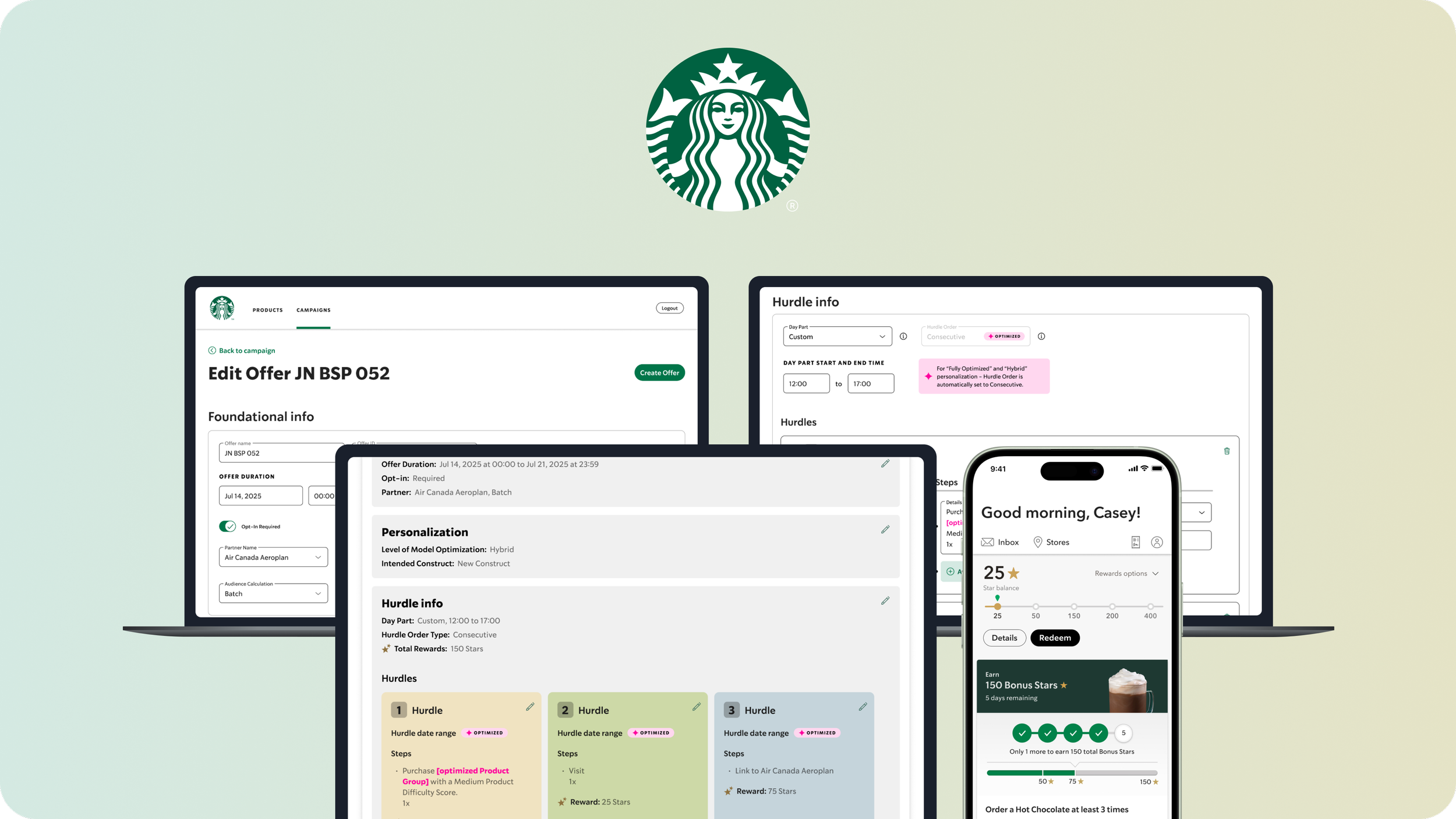
Impact
Increased operational efficiency
Reduced average campaign creation time - from ~90 minutes to ~45 minutes.
Reduced average time to validate campaign draft and publish - from ~50 minutes to ~15 minutes.
Increased employee satisfaction (through qualitative feedback)
Created an internal tools Design System
Unlocked the ability to create new Offers constructs and integrated AI personalization
Business revenue increase from new offer types - measurement in progress
Better brand image from more personalized Offers - measurement in progress
The project at a glance
Project duration: June 2025 to August 2025
Shipped: September 2025
Team: 1 Senior Product Designer (me), 1 Technical Product Manager, 6 Software Engineers
Stakeholders: Starbucks Loyalty Marketing Manager, Starbucks Loyalty C-Suite Leadership
Context - what state was Starbucks in around the start of the project?
Starbucks as a whole
In 2024, Starbucks had lost a lot of revenue and brand image, due to customers getting increasingly frustrated with rising product prices and contentious political statements. We needed a strategy to remedy this and get the brand back on track.
Starbucks Loyalty business
Around the same time, Loyalty leadership decided to switch our Campaign Manager host to another external vendor, Adobe. We were already using Adobe for other Loyalty-related services, so they wanted to cut costs.
What exactly is a Personalized Offer?
These are essentially “challenges” that appear 2-3 times a week on a customer’s Starbucks app, gamifying the Starbucks experience and rewarding customers for engaging with our brand.
They consist of:
Action(s) required
Rules for that action(s)
Reward given as a result of completing those actions
What is an Offer construct?
An “Offer construct” is just a unique type of Offer with a unique combination of Action + Rules + Rewards, created to help achieve a unique business goal.
As of September 2025, we have 11 constructs.
Why are Personalized Offers important to the Starbucks Business?
It’s a big chunk of the revenue pie
Personalized Offers (when personalized effectively) encourage more purchases and customer engagement with the brand, historically making up to ~30% of Starbucks revenue. We have other types of deals and discounts too at Starbucks, but less lucrative than Offers and getting less attention.
Customers say it keeps them coming back to Starbucks
Time and time again, through customer feedback, Personalized Offers are cited to be one of the ingredients keeping customers coming back to Starbucks.
These Offers campaign were created through a product originally hosted by an external company — and it had some problems
We didn’t know what our vendors’ UI looked like when taking on this initiative (it was very restricted to certain users) — but we did have employee feedback and data on its problems. We distilled it into 2 themes.
Product problem 1
The Offers creation experience was very confusing - highly complex with little guidance or clear info on what the user is configuring.
Product problem 2
The Offers creation experience couldn’t support robust personalization.
It didn’t support robust Offers constructs, limiting what employees could build.
It was highly manual.
This led to user and business problems.
Product problem 1
For users, this led to:
Marketing Operations ICs spending excessive time creating campaigns, averaging around 90 minutes before they could submit them for approval.
Marketing Operations Managers frequently needing to correct campaign configurations, requiring an average of 2 additional review cycles (3 total) before approval.
For the business, this led to:
Campaign creation being operationally inefficient, reducing organizational capacity. As a result, the Loyalty Marketing team spent more time producing campaigns and less time executing strategic marketing initiatives.
Product problem 2
For users this led to:
Employees not being able to create Offers that address evolving customer and business problems.
Employees not being able to create high-performing campaigns.
For the business this led to:
Limited Marketing Capabilities
Lower brand image (especially damaging with Starbucks’ current state)
Missed potential to rebuild revenue
Missed potential to rebuild brand image
We had 3 user groups for this product, with their own unique goals
Primary audience
Marketing Operations (individual contributor)
“When Loyalty leadership defines a new Offers campaign to achieve specific business goals, I want to easily and accurately configure the campaign according to the provided business rules, so I can help my team successfully execute those goals.”
Secondary audience
Marketing Operations (manager)
“When my Marketing Operations IC has finished creating an Offers campaign, I want to easily and accurately review and publish the campaign, so I can ensure it launches correctly and supports our business goals.”
Tertiary audience
Loyalty Marketing Strategy (individual contributor)
“When the Loyalty business has a business problem that one of our current constructs can’t solve, I want to explore new Offers constructs and view a concise summary of it, so I can determine if this would help solve those problems before pitching it to leadership.”
But we had some opportunities on our side
Switching to Adobe meant we could build the Campaign Creation UI in-house.
This meant we could freely control the design and experience.
Loyalty leadership was open to new ideas that could help with our business problems.
As a result of the company being in distress. This meant we could add things such as Offer hurdles, new Offer constructs, new Rewards, etc.
We had our own in-house AI system that was robust and knowledgeable on customer profiles and behaviors.
This meant we could leverage this to provide more personalization.
So we defined our business and design goals, and set out to build a new Campaign Manager
Business goals
Increase operational efficiency by reducing the time and effort required to create and approve marketing campaigns.
↓ Average campaign creation time
↓ Average review cycles (from 3 to 2)
Business revenue increase from new types of Offers.
Better brand image from Offer constructs that resonate more with customers.
Design goals
Clearer and more intuitive Offers Creation experience
Better IA + step by step flow
Better headlines / conversational language
Comprehensive, easy-to-understand summary
Build flexibility for blue-sky Offers constructs
Add hurdles experience
Add new types of rewards (combined with research on what type of reward resonates best with what type of customer)
Integrate an intuitive AI experience that is easy to understand, use, and builds trust in user
Our solution
Images coming soon.